What the Industrial Hemp Pilot Program taught us about agriculture, regulation and the responsible future of cannabis and the plan ahead
Call to action
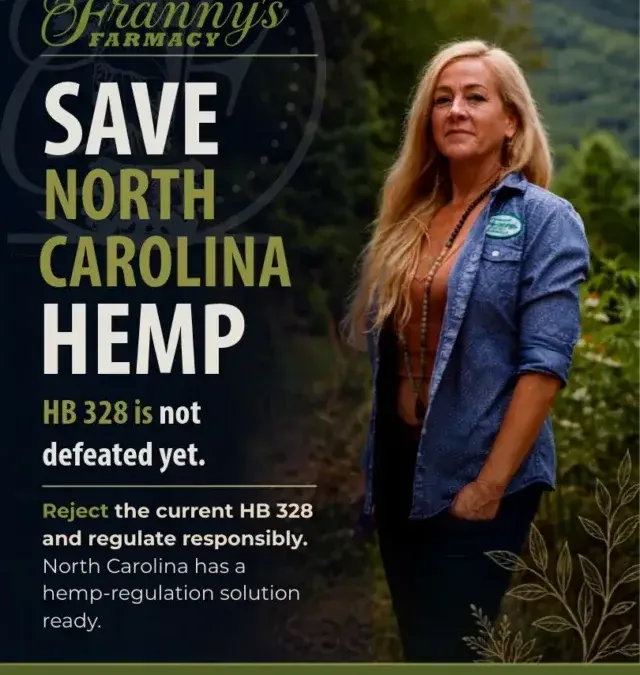
Join Save NC Hemp and ask North Carolina lawmakers to create comprehensive, adult-focused hemp regulation through licensing, independent testing, safe packaging, truthful labeling and meaningful enforcement.
�———————————————————————————————————————————–
Nine years ago, North Carolina stood at the edge of a field it had never planted.
There was no established state hemp industry. There were no familiar licensing procedures, no mature supply chain and no clear roadmap showing farmers, regulators or financial institutions exactly what would happen next.
Questions were everywhere.
Who could grow the plant? Where could it be planted? How would it be tested? Who would supervise the program? How would law enforcement distinguish hemp from marijuana? What research was required? Could farmers find buyers? Would banks work with them? Would consumers understand what hemp was�or would fear and stigma stop the program before it began?
We did not have every answer.
But North Carolina began building a system.
That history matters now because, once again, our state is being told that hemp and cannabis are too complicated to regulate responsibly.
I do not believe that is true.
North Carolina has already shown that it can take a controversial plant, establish rules, license participants, monitor cultivation, learn from experience and develop an entirely new agricultural sector.
We helped build the first system.
We support regulation.
We are ready to help build the next one.
How North Carolina�s hemp program began
The modern story began with the federal Agricultural Act of 2014. That law allowed qualifying state departments of agriculture and universities to cultivate industrial hemp through authorized research pilot programs.
North Carolina followed with Senate Bill 313, enacted as Session Law 2015-299. The law recognized the legitimacy of hemp research, created the North Carolina Industrial Hemp Commission and authorized a system for licensing growers and supervising cultivation. It also identified hemp as a potential source of agricultural employment and economic development.
Unlimited public funding was not included..
An important factor required it to secure $200,000 from non-state sources before the Commission could exercise its statutory responsibilities. Farmers, advocates, businesses and other supporters therefore had to help provide the resources and momentum necessary to move the program from legislation into operation.
North Carolina hemp was not created by the government acting alone. It was built by cooperation amongst lawmakers, regulators, farmers, universities, attorneys, advocates, researchers and private citizens.
My own role was one part of that larger effort.
I advocated, I educated, I helped raise awareness, funds and signatures. I spoke with farmers and citizens who had been taught to fear the plant. I tried to make the case that hemp could be regulated, researched and grown responsibly.
Many people created the program.
I added my piece to the puzzle.
From legislation to living fields
By March 2017, temporary rules were in place and the state was accepting applications. By June, more than 60 approved farmers had begun planting under the new program.
Those first licenses were not symbolic pieces of paper.
Growers had to identify where hemp would be cultivated. The governing legislation required legal descriptions and GPS coordinates for authorized fields. The program created rules surrounding planting, cultivation, testing and the responsibilities of license holders.
For those of us in the fields, regulation was not an abstract political word.
It was part of every planting decision.
It determined where seed could come from, where it could be grown, how a crop would be documented and what would happen if its cannabinoid levels fell outside the permitted standard. It shaped conversations with banks, insurers, suppliers, researchers and law enforcement.
There was confusion. There was resistance. There were gaps that had to be corrected.
But the system functioned.
Farmers planted. Researchers collected information. Regulators gained experience. Universities studied the crop. Businesses began developing products and markets. Citizens learned that industrial hemp could exist within a legal and supervised agricultural framework.
That was a significant public-policy accomplishment.
What the pilot program gave North Carolina
The program did more than authorize a crop.
It created knowledge.
North Carolina learned how to issue licenses, document cultivation sites and communicate with growers. Farmers learned about genetics, soil conditions, planting density, harvest timing and market volatility. Regulators learned where rules needed clarification. Researchers gained access to a crop that had been absent from modern American agriculture for decades.
The public also learned.
Essential education dispersed through farm tours, conferences, classroom presentations, field days and hundreds of conversations that allowed people to begin separating the facts about hemp from generations of stigma.
Laws cannot succeed when the public does not understand the subject being regulated.
Over time, the federal framework changed. The 2018 Farm Bill established a national hemp production system, and North Carolina later ended its state pilot program as federal USDA oversight took effect. Today, qualifying North Carolina growers obtain production licenses through USDA, which administers applications and reporting through its Hemp eManagement Platform.
The original program therefore did what a pilot program is supposed to do.
It opened a lawful pathway, produced practical experience and helped move the crop into a more permanent regulatory structure.
What the first system did not finish
Let�s be honest about what remained unresolved.
Most early hemp regulation focused on the plant at the farm level: who could grow it, where it was cultivated and whether the crop complied with the legal THC standard.
But the marketplace did not stop at the farm gate.
Hemp moved into extraction, manufacturing, distribution and retail. New product categories developed faster than state and federal consumer-product rules. Standards for finished products remained inconsistent. Responsible companies created their own testing, labeling and manufacturing practices, while less responsible operators exploited gaps.
That does not prove regulation failed.
It proves regulation remains unfinished.
We learned that cultivation oversight alone is not enough. A mature system must follow the product through manufacturing and sale.
It must protect the farmer and the consumer.
Regulation or prohibition as an ultimatum is a false choice
North Carolina is often presented with two extremes.
At one end is a marketplace with insufficient licensing, uneven product testing and inconsistent enforcement.
At the other is a restrictive system that removes most lawful products and businesses rather than regulating them.
Those are not our only choices.
The responsible hemp industry has repeatedly asked for clear rules. The Save NC Hemp strategy is not built around preserving every product or defending every seller. It is built around protecting a lawful, accountable market and separating responsible operators from businesses that endanger consumers.
A January 2026 economic analysis estimated that North Carolina�s hemp-derived cannabinoid industry now generates approximately $3.2 billion in business revenue, supports more than 16,000 jobs and pays approximately $702.5 million in wages. The report concludes that moving from self-regulation toward product-level regulation represents a practical middle ground compared with a blanket ban. (Whitney Economics Report)
That does not mean economic value should outweigh safety.
It means North Carolina has both the responsibility and the incentive to regulate this market carefully.
What a responsible North Carolina system should include
A credible framework should begin with one clear principle:
Products capable of causing intoxication should be regulated as adult products.
Sales should be limited to adults 21 and older, with identification verification in stores and meaningful age controls for online purchases and delivery.
Age restrictions are only the beginning.
A complete system should include:
- Licensing for manufacturers, distributors and retailers.
- Registration of finished products sold in the state.
- Independent batch testing by qualified laboratories.
- Testing for cannabinoid potency, pesticides, heavy metals, residual solvents and microbial contaminants.
- Certificates of analysis available through QR codes.
- Accurate disclosure of milligrams per serving and per package.
- Child-resistant and tamper-evident packaging.
- Restrictions on packaging designed to imitate children�s candy or snacks.
- GMP or comparable manufacturing standards.
- Traceability, adverse-event reporting and recall procedures.
- Enforcement against unlicensed and noncompliant sellers.
- Meaningful penalties for repeat violations.
- Reasonable potency and serving limits based on product category and evidence.
- A transition pathway that allows existing compliant businesses to meet new standards.
- Collection of appropriate state and local taxes.
Most importantly, the rules should be built with participation from the people who understand each part of the system:
Farmers. Manufacturers. Independent Laboratories. Retailers. Health professionals. Attorneys. Researchers. Consumers. Public-safety representatives.
Regulators should not be asked to design the entire market in isolation, and businesses should not be permitted to write their own rules without public accountability.
A durable system requires both expertise and oversight working dynamically.
We have done difficult work before
North Carolina did not begin its hemp pilot program because every question had already been answered.
It began because people were willing to create a lawful structure, gather evidence and improve the system over time.
We can do that again.
We do not need to repeat every decision from the original pilot program. We can build upon what worked, correct what did not while extending oversight beyond the farm gate.
The lesson of the pilot program is not that North Carolina got everything right.
The lesson is that North Carolina was capable of beginning and capable to continue.
Our state brought lawmakers, farmers, regulators, researchers and businesses into a new agricultural framework. It established licensing and compliance requirements. It gathered real-world experience. It helped turn an uncertain crop into a significant statewide industry.
Now, as HB 328 threatens to undo years of progress, North Carolina must continue the work.
Now we must finish what we started.
Follow Save NC Hemp.
Join the coalition.
SAVE NC HEMP https://www.ncleg.gov/findyourlegislators
Tell North Carolina lawmakers to convene the people who grow, manufacture, test, sell, study and use these products�and build an enforceable system that protects adults, children, consumers, farmers and responsible businesses.
We helped build the first system.
We support regulation.
And we are ready to help build the next one.